

When Reliability Isn't Just Important - It's Mission Critical
We help engineers and designers transform vulnerable components into durable systems with precision resin encapsulation, custom resin casting, and high voltage protection — engineered for harsh, real-world environments.
Resin Encapsulation Challenges We Solve
Custom-Fit Resin Moulding for Complex Designs
Your challenge: “Standard enclosures don’t fit — and compromise performance.”
Our solution: We create custom-fit resin mouldings tailored to your geometry and environmental needs — delivering protection without compromise.
Fast Resin Prototypes for Testing & Validation
Your challenge: “We need to prove it works — before production.”
Our solution: We produce accurate, testable prototypes quickly, giving you confidence in real-world conditions — so you can move forward without delays.
Reliable Resin Protection in Harsh Environments
Your challenge: “Our components live where heat, voltage, and moisture meet.”
Our solution: We combine the right resin chemistry with the right process — from high-voltage epoxy systems to flexible urethanes — so your parts stay protected, connected, and reliable under real-world stress.
Why Engineers Choose Our Resin Solutions
Custom Solutions
Every challenge is unique. We design and deliver encapsulation strategies tailored to your requirements.
One Team. Every Step.
We manage the entire process in-house, giving you tighter control, fewer delays, and total peace of mind.
Trusted Quality
Certified to ISO 9001 and ISO 14001 standards — delivering quality you can trace and responsibility you can trust.
Collaborative by Design
We work like an extension of your team — responsive, transparent, and always focused on what matters to your project
Our Core Resin Encapsulation Services


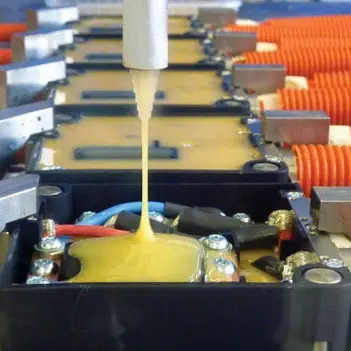


Let’s Start Your Resin Encapsulation Project
Let's take your business to the next level!
Frequently Asked Questions
What factors determine the most suitable encapsulation material for an electronic assembly?
Material selection depends on operating temperature, thermal conductivity, dielectric strength, moisture resistance, chemical exposure and mechanical loading. Engineers must also consider cure characteristics, adhesion to substrates and compatibility with sensitive components. Silicone, epoxy and polyurethane systems offer different performance characteristics depending on the application's requirements.
How can thermal expansion mismatch be managed in encapsulated electronic components?
Differences in coefficients of thermal expansion between encapsulants, substrates and electronic components can generate internal stresses during temperature cycling. Selecting materials with appropriate modulus and expansion characteristics, alongside suitable component positioning and encapsulation geometry, helps reduce the risk of cracking, delamination and solder joint fatigue.
What considerations influence encapsulation performance in high-voltage applications?
High-voltage applications require careful evaluation of dielectric strength, volume resistivity, insulation thickness and resistance to electrical tracking. Air entrapment, contamination and inadequate material coverage can compromise insulation performance. Material selection and process control should therefore reflect the required electrical clearances, environmental conditions and relevant testing standards.
How does encapsulation affect heat dissipation in power electronics?
Encapsulation can influence thermal performance by altering the heat-transfer path between electronic components and their surroundings. Thermally conductive formulations may improve heat transfer to suitable heat sinks or enclosures, although overall performance depends on geometry, interface contact, filler loading and thermal resistance throughout the assembly.
What manufacturing controls help minimise void formation during encapsulation?
Void formation can be influenced by material viscosity, mixing methods, component geometry, dispensing technique and cure conditions. Controlled mixing, appropriate degassing, consistent dispensing parameters and validated process settings help minimise trapped air. For critical applications, inspection and testing procedures may be required to confirm acceptable encapsulation quality.
How should encapsulation systems be evaluated for chemical and environmental resistance?
Environmental performance should be assessed against the specific chemicals, moisture levels, temperatures and exposure durations expected in service. Compatibility testing may include immersion, accelerated ageing, thermal cycling and humidity exposure. Changes in adhesion, hardness, dimensional stability and electrical properties can indicate whether a formulation is suitable for the intended operating environment.
What are the principal differences between epoxy, polyurethane and silicone encapsulation systems?
Epoxy systems are frequently selected where structural rigidity, adhesion and chemical resistance are important. Polyurethane systems can offer a balance of flexibility, mechanical protection and processing characteristics. Silicone systems are often considered where temperature stability and low mechanical stress are priorities. Final selection depends on the specific formulation and application requirements.
How can encapsulation processes be adapted for complex component geometries?
Complex assemblies may contain narrow cavities, closely spaced components, undercuts and areas where air can become trapped. Material flow characteristics, dispensing locations, component orientation and tooling design must be considered. Process development may include controlled dispensing sequences, vacuum assistance and validation trials to establish consistent material coverage.
What testing methods can be used to validate encapsulated assemblies?
Validation methods depend on the functional requirements of the assembly and may include dielectric testing, insulation resistance measurement, thermal cycling, vibration testing, humidity exposure and mechanical inspection. Where appropriate, destructive sectioning or imaging techniques can be used to assess internal coverage, adhesion and void formation. Acceptance criteria should be established against the product specification.
What information should be provided when requesting a technical encapsulation quotation?
A detailed technical enquiry should include component drawings, dimensions, substrate materials, operating temperatures, electrical requirements, environmental exposure, anticipated production volumes and any applicable industry standards. Information about preferred materials, tooling constraints, inspection requirements and expected service life can also help establish a suitable manufacturing approach and accurate quotation.
